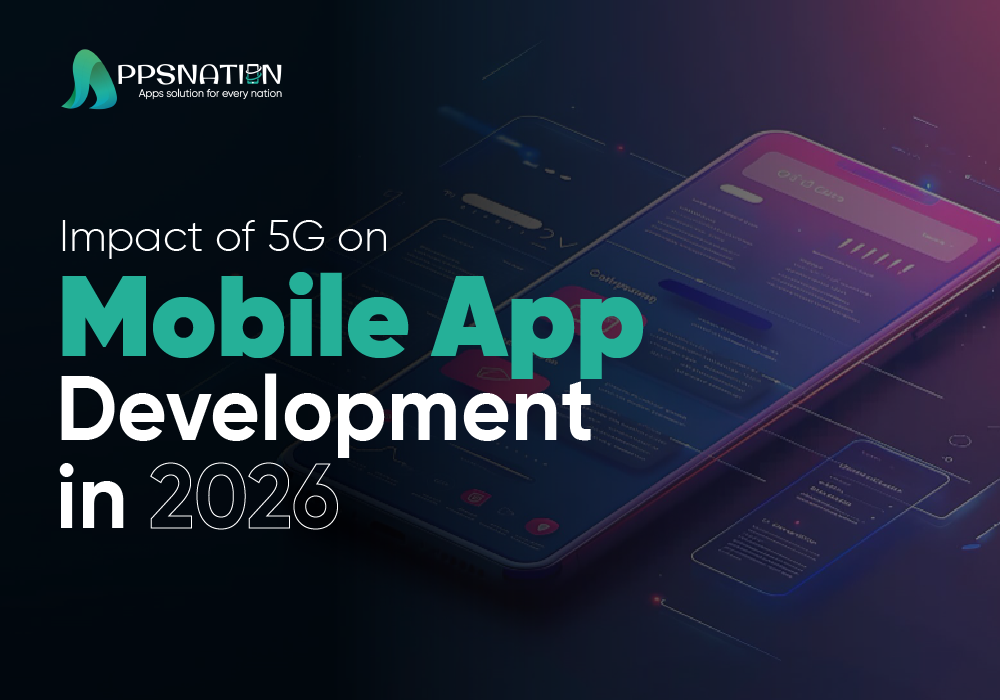
With 5G, the pace of mobile app development is changing. 5G is the new impact technology. It’s not just an upgrade, it’s changing the way we innovate. There is a shift now to real-time, data-driven experiences to truly immersive augmented reality (AR), real-time cloud gaming, and smart Web of Things integration. The developers will prepare high-value mobile applications and custom platforms to enable better integration among devices and applications.
The Beginning of the New Era: Real-Time AR, VR, and Cloud Gaming
Technology is constantly changing as the world does. The development of technologies like Augmented reality( AR) and virtual reality( VR) has witnessed some radical transformations with the introduction of 5G technology. The 5G technology has been implemented to achieve faster speed. It made it possible to stream augmented and virtual reality apps with complex and interactive architectures in real time. This revolutionizes the cloud console, as 1G sites and any other console-quality games can be played on mobile devices. The devices themselves can also harness the cloud. It enables more complex and visually stunning applications.
The Rise of Ubiquitous Connectivity for IoT and Smart Devices
The numerous devices and the 5G technology have also enhanced the performance of mobile apps together. It enables more complex systems such as smart homes, cities, and even industrial applications. These mobile apps can now serve as hubs that manage multiple devices. They can span sensors and devices in real time. These base monitoring systems revolutionize smart health monitors. It allows real-time transmissions to doctors as well as traffic management systems. It can manage the traffic easily.
Enhancing User Experience with Faster Data Transfer
The increased speed for 5G technology users improves customer retention. Video meetings, remote machine operations, and even simultaneous translation services will get an almost instant response time. Due to this technology of 5G and edge computing, different apps will be able to load images, videos, and even high-resolution files with fast loading time. It satisfies the consumer to a great extent.
Rethinking App Architecture for Edge Computing and Distributed Services
5G integration has prompted a shift in app development from server-centric models to a more edge computing approach. Edge computing devices store data that has been processed close to the data source, rather than sending data to a distant data center. The processed data is more appropriate for applications. It involves autonomous vehicles or continuous wireless health surveillance. When edge computing co-ordinates with a distributed model, it will enhance the existing cloud model. It results in greater user privacy and more responsive applications.
The effects that 5G will have on mobile applications development are transformative mostly due to the amazing speed, and very high network capacity of the new generation for 5G over the older generation such as 4G. These fundamental innovations create a new type of apps and remodel the current user experiences to a large extent.
Redefining App Architecture and Performance
The gigabits speeds of 5G significantly decrease the time of app download and loading; the preliminary user experience is instantly improved. It enables transitioning to cloud-native and edge computing systems. Real-time data analytics and instant feedback loops can be used by developers. The increased network capacity guarantees the performance even in congested locations. It makes the apps fast and stable.
Expanding the Internet of Things (IoT) Ecosystem
The high density of connected devices (of up to a million devices per square kilometer) that can be supported by 5G is what underlies the smooth integration of IoT. A high number of smart devices and sensors can be managed and communicated with the use of mobile apps. It opens up new opportunities to industry specific applications in healthcare and logistics.
Accelerating the Shift to AI-Powered Personalization
The combination of the ultra-low latency of 5G and Edge Computing is the key driver of a move into a hyper-personalized experience of the app. It now allows developers to execute more sophisticated AI models nearer to the user, potentially delivering real-time behavioral analytics and immediate context-dependent suggestions (e.g., location, time of day, current activity), as well as allowing Generative AI to be integrated into customized assets with ease.1 Finally, with 5G and AI, the apps will be able not only to respond, but to anticipate each individual user need, which will create an even higher benchmark of interaction and client retention.
Monetization and Business Model Transformation for Developers
The technology supports the development of high-end, high-bandwidth services, including advanced AR/VR functionality, real-time massive multiplayer cloud games, and ultra-HD live streaming experiences, which warrant premium price tiers, which can be transferred to enterprise or pro-consumer subscribers.3, also, with the emergence of Network Slicing, Quality-of-Service (QoS) monetization is a possibility, and developers can now afford to pay to be guaranteed ultra-low latency or ultra-fast slice, and can pass the value on to enterprise or pro-consumer customers The change facilitates value based pricing and creates an alternative of revenue on the basis of providing high quality and low latency performance.
Conclusion
This deep technology does not only enhance the pace of the existing trends, but it also introduces new applications. It enables them to create more immersive connected intelligent experiences. Mobile devices are being redefined by the transition to real-time AR/VR, cloud gaming without interruption, and a robust system of IoT. The history of mobile app development in the 5G era is not like any other. The mobile applications are responsive and connected as never before. It is being constructed on 5G technology.
FAQs
How do users of apps leverage 5G speed?
Of course, 5G is not expected to fully replace Wi-Fi, but it is altering the way people use it. It allows users to have quality connections. It reduces the necessity to use Wi-Fi. Conversely, Wi-Fi would still continue to play a significant role in the area of indoor applications. It is also in equipment that lacks cellular connectivity.
Does 5G eliminate the use of Wi-Fi?
Of course, 5G is not expected to fully replace Wi-Fi, but it is altering the way people use it. It allows users to have quality connections. It reduces the necessity to use Wi-Fi. Conversely, Wi-Fi would still continue to play a significant role in the area of indoor applications. It is also in equipment that lacks cellular connectivity.
What is edge computing and what is its significance to 5G applications?
Edge computing Edge computing is a paradigm of distributed computing in which data processing is brought as close to its source as it can be instead of a remote cloud computing device. It is of importance to real-time applications. It contains self-driving cars, virtual reality or industrial robots, where the target is to save in every millisecond.
What are the effects of 5G on the creation of AR and VR applications?
The 5G is a revolutionary one in AR and VR applications. The developers are now in a position to develop elaborate multi-layered AR and VR experiences. It will be possible to have immersive tours in mobile devices and interactive textbook applications.
How does 5G impact monetising apps and business models?
The monetization prospects and versatile business models are increasing with the 5G technology. The technology allows mobile developers and designers to deliver contents that are in-depth and engaging, as the technology offers more speeding. Such a vast amount of content can be monetized with the help of subscriptions and in-app purchases. Cloud gaming and live streaming are also getting better and subscription based contracts are becoming more attractive. Moreover, more diverse business models of IoT and B2B can be facilitated by the possibility to connect large numbers of devices.