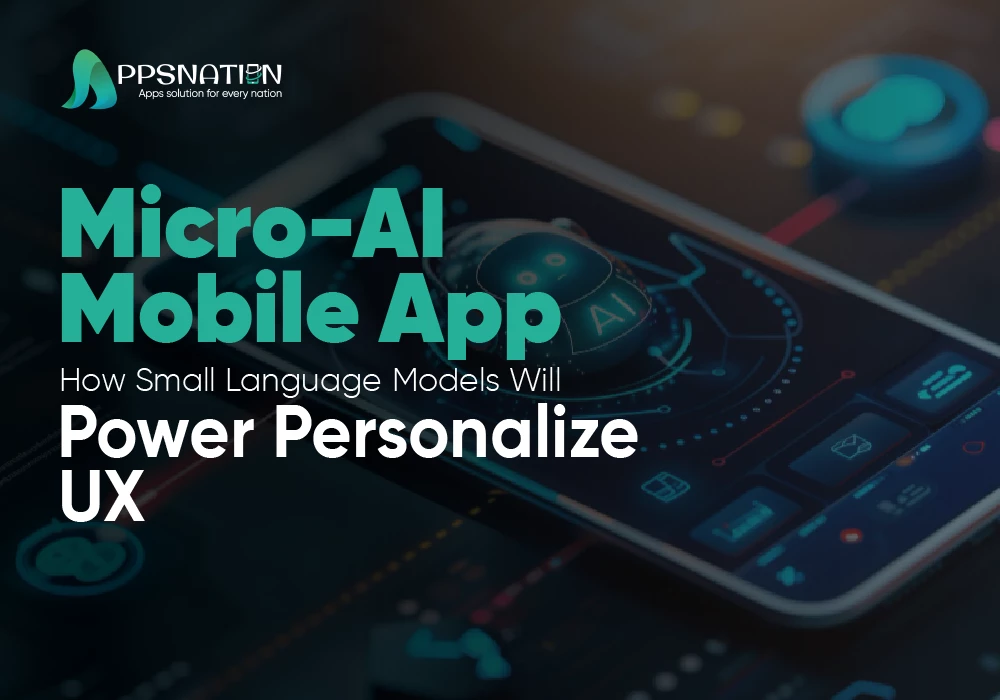
The emergence of Micro-AI is transforming mobile applications and bringing a new wave of personalization and responsiveness that is driven by Small Language Models (SLMs). These optimized models, cloud-dependent AI, can be directly executed on devices, giving instant and context-aware intelligence, yet preserving the privacy of the user. To developers, Micro-AI democratizes higher-order AI functions, so that entities like small studios creators can add powerful, real-time functionality which previously had been reserved by tech giants.
In addition to its accessibility, SLMs transform the experience itself. Apps are changing the ways of being reactive to tools, turning into proactive digital companions that can predict user needs, offer predictive tips, and adjust to behavior, location, and activity in a seamless way. This ultra contextual responsiveness eliminates friction, develops trust and fosters highly personalized engagements. With the shift in mobile ecosystems accepting this change, the integration of efficiency, privacy, and intelligent human-like applications will place Micro-AI applications set to reshape user expectations and open the next wave of customized and personalized mobile experiences, by merging the boundary between technology and human-centric design.
Edge AI and On-Device Processing
The concept of Edge AI is the implementation of computational tasks, namely Small Language Models (SLMs), on the cloud servers that are not centralized and on the device that is owned by the user (the edge). This change is essential due to minimizing the delays in transmitting data and maintaining a smooth flow of performance even in the case of poor or non-existent network connection. Mobile applications can respond to complex problems on par with the speed of even their AI equivalents, such as text generation or deep image analysis by committing local resources to AI inference, resulting in near-instantaneous response times. This infrastructure transformation minimizes the use of expensive cloud APIs in all user interactions and, therefore, it allows scaling and robust features in a wide range of hardware. On- Jugging is therefore the technical basis of the Micro-AI movement.
Optimization and Architecture of SLM
The Small Language Models (SLMs) are trained using intensive distillation and pruning for making sure they preserve the most crucial intelligence of their larger foundation models with significantly fewer parameters. The consequence of such optimization in architecture is a model that is small enough to execute on mobile System-on-Chips (SoCs) with minimal memory and battery capacity. The most important optimization tricks are quantization, that is, lowered accuracy in weights without much accuracy loss, and the model compression tricks. This is aimed at trying to realize the optimal performance-to-size ratio, whereby state-of-the-art features can be realised locally without affecting the overall speed of the device or its battery life. SLM architecture is a success story of the engineering trade-offs that are concentrated on mobile utility.
Instantaneous Inference of Locality
The main benefit of Micro-AI to the user is that it can be used to complete local inference immediately and removes the latency caused by sending the data to the cloud round trip. In the case of a user querying a large cloud model, the time spent is the time to upload the data, cloud processing as well as downloading the result; SLMs eliminate this time completely. This is a revolutionary pace of very high frequency interactions such as real-time predictive text, instant translation and on-the-fly content summarization. To the end-user, this translates to a frictionless experience and AI features seem natural and deeply integrated as opposed to an outsourced service. This is the immediacy which leads to a proactive user experience.
The Privacy-First Advantage
Among the strongest benefits of on-device SLMs, it is possible to note the natural improvement of user privacy and data security. Since query processing and contextual information processing involve the sensitive user data, the user queries and the situation are processed locally, a third-party server does not need to receive the data to infer it. This will minimize the area of possible data breaches and is consistent with emerging global data residency and privacy laws (such as GDPR). Developers can have a stronger user trust and confidence by providing intelligent AI solutions that are privacy-first in nature. The given paradigm enables the delivery of personal services without infringing on the digital autonomy of the user.
Context-Aware and Proactive UX
Micro-AI allows making a radical change between a reactive application interface and a proactive and context-sensitive interface. As the SLM works locally, it is capable of analyzing the local environment of the user, which includes location, time, device usage, and current application state, at any given time. This enables the application to infer the next move or information requirement by the user and give solutions prior to them being entered as a request. They can be things like switching back and forth between languages instantly depending on where the user is or creating applicable summative notes depending on the past five minutes of screen time. Such predictive features ease the load on the brain, making the application a very compelling digital assistant.
Democratizing High-End AI
Being made accessible commercially in compact and efficient versions democratizes access to powerful artificial intelligence, breaking the moat of infrastructure that once sheltered the technology giants. Smaller development teams and lone coders can now add the state of the art capabilities such as natural language conversation and sophisticated reasoning into their applications and avoid the prohibitive cloud computing expenses. This reduces the entry barrier, creates stiff competition in features and increases innovation throughout the mobile app ecosystem. Through the democratization of high-end AI, innovation is no longer limited by the budget, but by the creativity of the developer and his/her expertise of the local user requirements.
Cost Effectiveness vs. Cloud Lock-in
The economic case of Micro-AI is very high: SLMs will radically lower the cost of operations associated with cloud dependencies. The cost of LLM is that developers charge per API call, which informs high costs of transactions that are linearly dependent on user interaction. Developers leverage a variable, expensive operational expense (OpEx) by shifting it to the user device to turn a fixed cost of development (CapEx). This model enables infinite scaling of features without a respective increase in cloud charges to maintain financial feasibility in the long-term, particularly with applications that have a high number of users, and high usage.
Conclusion
The emergence of Small Language Models (SLMs) is an indicator of the final doom of cloud-based mobile AI. The Micro-AI revolution focuses on on-device processing, and as a result, it essentially reinvents application architecture with instantaneous local inference and strong data privacy being prioritized. The ability to remove cloud latency and the risk associated with transmissions is a strong privacy-first feature of SLMs. Moreover, because this democratization of complex AI reduces the entry price, it promotes a cycle of fast innovation within the mobile ecosystem. The future of mobile development is the proactive and personalized application that will use local intelligence to provide a seamless, intuitive and highly context-aware user experience and will hasten the process of achieving a truly intelligent mobile computing substantially.
FAQs
So, what is a Small Language Model (SLM) and what is its difference with a large LLM?
An SLM is a compressed and highly efficient version of a Large Language Model (LLM). Whereas LLMs (such as GPT-4) have hundreds of billions of parameters, and need massive cloud servers, SLMs are pushed down to a few billion parameters, either by quantization or pruning. This is shrunk down to be able to directly execute on the limited hardware of mobile and edge gadgets, with velocity.
What are the key advantages of On-Device Processing to the end user experience?
The first advantage is immediate inference. On-device SLMs can be used to provide the local processing of queries and eliminate the network latency of transmitting data to and from the cloud. This produces zero-lag, real time capability such as predictive text, real-time transcription, and intelligent content filtering. In addition, it ensures that it works even in the absence or poor internet connectivity by the user.
What is the effect of AI development democratizing through the adoption of SLMs in the mobile market?
The monetary list of entries to create more refined AI features is reduced significantly by SLMs. In the past, cloud computing required high operational costs, which repeated with each API call and were only affordable to large companies. Small developers reduce the high variable costs that the cloud would bring by shifting the processing power to the device of the user, creating a fixed cost of development. This allows the ubiquitous use of high-end AI by any developer, increasing competition and innovation.
What are the benefits of SLMs to a Proactive User Experience (UX)?
Local execution of the AI model enables the app to perform a constant and real-time analysis of the local data streams (such as GPS, accelerator, as well as the latest app usage) to ensure the prediction of user intent. The app can preempt needs, like the generation of a list of notes following a meeting, or provide contextual travel recommendations, unlike waiting until the person requests it (proactive versus reactive).
What are the most important technical difficulties of implementing SLMs to mobile devices?
The main obstacles are based on the resource limitation: memory and power. The developers are forced to use extreme optimization methods (such as model compression and quantization) to make the model fit the device with limited RAM and be efficient without over-consuming battery power. Trading model size versus reasonable accuracy and performance on a wide hardware profile is a long-lasting engineering challenge.
Will Micro-AI become an overall replacement of Large Language Models (LLMs)?
No, SLMs are not supposed to substitute LLMs; on the contrary, they complement each other. SLMs are also speedy, efficient, and locally, context-sensitive (e.g., immediate chat responses, translation). Computationally intensive tasks with a depth of immense knowledge as in complex reasoning, code generation, or synthesizing immense volumes of global data all still require LLMs. A hybrid architecture of both types of models communicating strategically will be experienced in the future.